Parity Twine: A Quantum Code to Connect Qubits
Wednesday, June 24, 2026 3:45 PM to 5:15 PM · 1 hr. 30 min. (Europe/Berlin)
Foyer D-G - 2nd Floor
Research Poster
Optimizing for Energy and PerformanceQuantum Program Development and OptimizationQuantum Computing - Basics and TheoryQuantum Computing - Technologies and Architectures
Information
Poster is on display and will be presented at the poster pitch session.
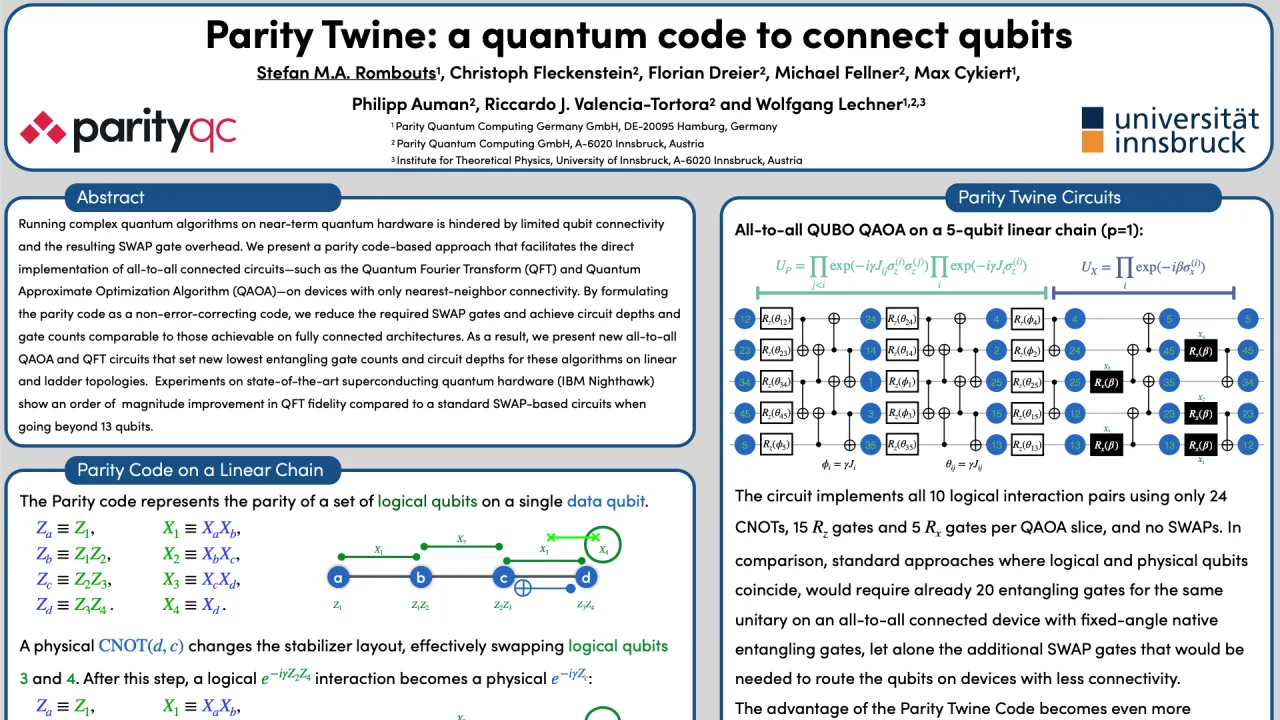
Running complex quantum algorithms on near-term quantum hardware is hindered by limited qubit connectivity and the resulting SWAP gate overhead. We present a parity code-based approach that facilitates the direct implementation of all-to-all connected circuits—such as the Quantum Fourier Transform (QFT) and Quantum Approximate Optimization Algorithm (QAOA)—on devices with only nearest-neighbor connectivity. By formulating the parity code as a non-error-correcting code, we reduce the required SWAP gates and achieve circuit depths and gate counts comparable to those achievable on fully connected architectures. As a result, we present new all-to-all QAOA and QFT circuits that set new lowest entangling gate counts and circuit depths for these algorithms on linear and ladder topologies. Experiments on state-of-the-art superconducting quantum hardware (IBM Nighthawk) show an order of magnitude improvement in QFT fidelity compared to a standard SWAP-based circuits when going beyond 13 qubits.
Contributors:
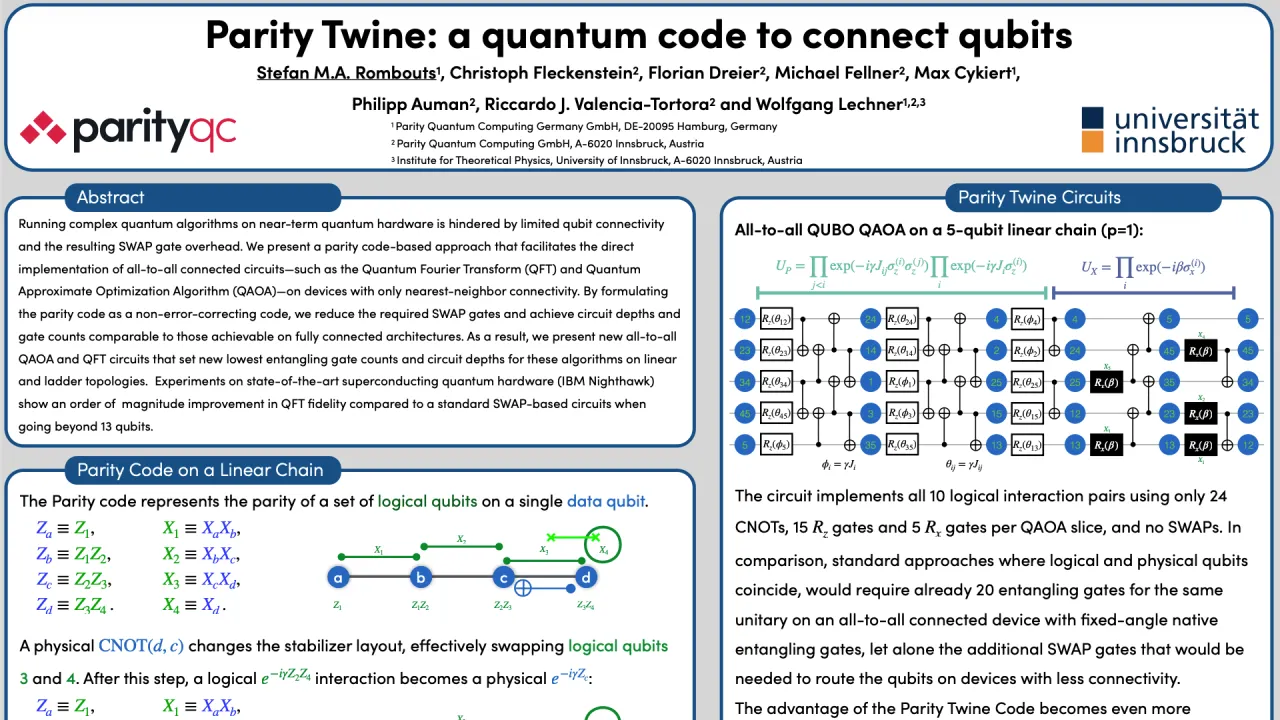
Running complex quantum algorithms on near-term quantum hardware is hindered by limited qubit connectivity and the resulting SWAP gate overhead. We present a parity code-based approach that facilitates the direct implementation of all-to-all connected circuits—such as the Quantum Fourier Transform (QFT) and Quantum Approximate Optimization Algorithm (QAOA)—on devices with only nearest-neighbor connectivity. By formulating the parity code as a non-error-correcting code, we reduce the required SWAP gates and achieve circuit depths and gate counts comparable to those achievable on fully connected architectures. As a result, we present new all-to-all QAOA and QFT circuits that set new lowest entangling gate counts and circuit depths for these algorithms on linear and ladder topologies. Experiments on state-of-the-art superconducting quantum hardware (IBM Nighthawk) show an order of magnitude improvement in QFT fidelity compared to a standard SWAP-based circuits when going beyond 13 qubits.
Contributors:
Format
on-demandon-site