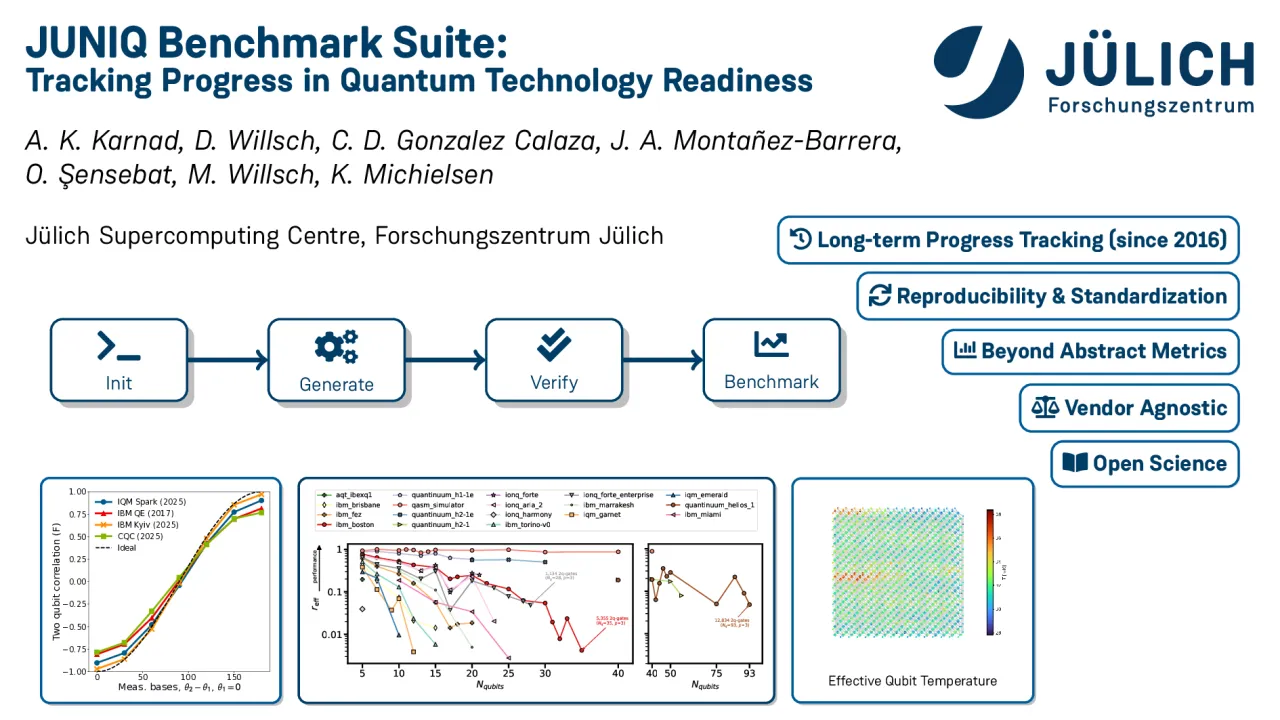
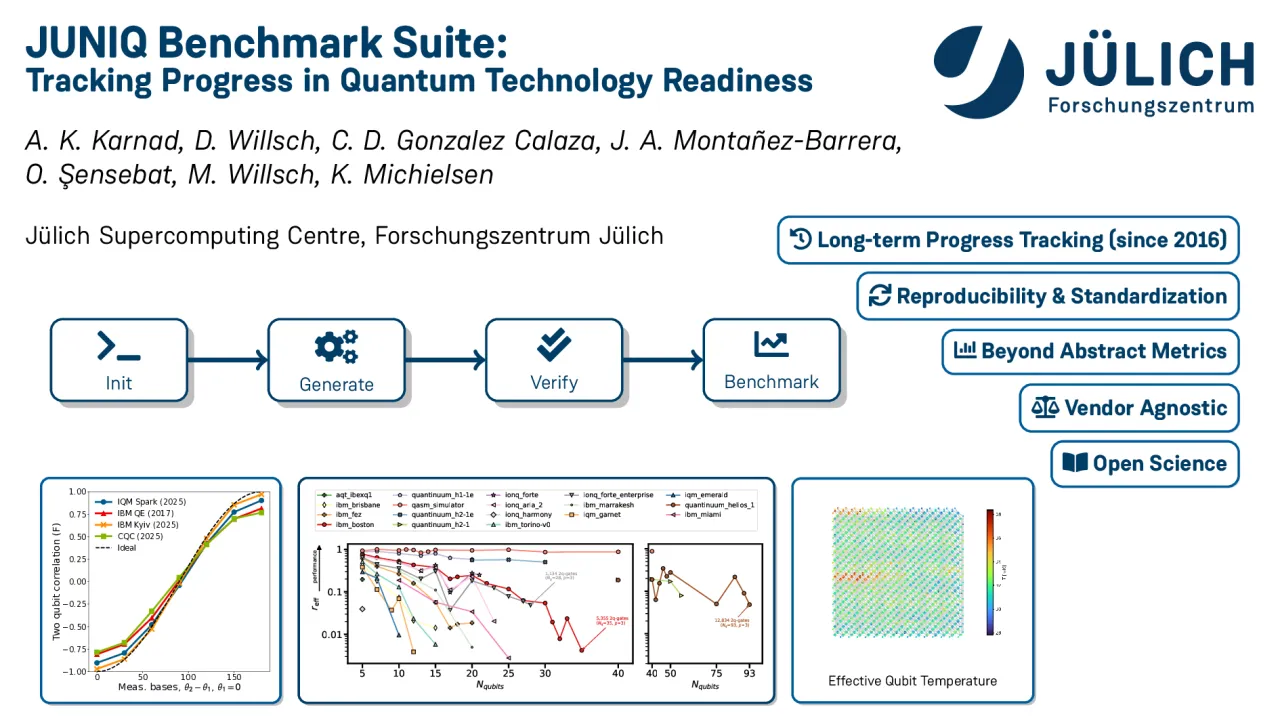
Poster is on display and will be presented at the poster pitch session.
As quantum computing hardware rapidly evolves, traditional metrics like gate fidelity and Quantum Volume are insufficient for predicting real-world utility. Researchers and industry users need objective, application-centric benchmarks to gauge when quantum processors will be ready for practical tasks. However, the lack of standardized infrastructure often leads to non-reproducible performance claims and makes it difficult to track progress across different hardware generations and technologies.
We present the JUNIQ Benchmark Suite (https://go.fzj.de/juniq-benchmark-suite-page),
a large collection of benchmark problems and a vendor-agnostic, open-source initiative provided by an independent research lab, designed to track quantum technology readiness over decades. Unlike suites focused on synthetic benchmarks, the JUNIQ Benchmark Suite emphasizes application domains. Examples include computational biology and remote sensing (Quantum SVM), logistics (Tail Assignment, TSP), and hardware diagnostics (Effective Qubit Temperature) etc. By benchmarking the same relevant problems on systems ranging from the earliest publicly available QPU devices (e.g. IBM Q Experience in 2016 and D-Wave 2000Q systems in 2017) to the latest state-of-the-art devices such as Advantage2 (2025), we provide a clear, overview of hardware maturation.
A key innovation of our work is the standardized benchmarking workflow, a CLI-based toolchain along with CI pipelines, developed to ensure strict reproducibility. This setup facilitates the entire benchmark lifecycle (setup, generation, verification and execution) while aiding dependency management and enabling CI testing. This ensures that previously generated problems remain reproducible in the future, solving the "dependency drift" problem common in the fast-moving quantum software ecosystem.
The JUNIQ Benchmark Suite hosts benchmark instances from various domains and is actively tracking performance on the latest analog and digital quantum processors available through the JUNIQ cloud platform and beyond. To foster a transparent ecosystem, we include templates and tooling that lower the barrier for community to contribute new problem instances.
Keywords: Quantum computing, Benchmarking, QPU, Quantum computing applications,
Contributors: