Mixed-Precision and Energy-Efficiency in SEM Codes
Wednesday, June 24, 2026 at 3:45 PM to 5:15 PM · 1 hr. 30 min. (Europe/Berlin)
Foyer D-G - 2nd Floor
Research Poster
Compiler and Tools for Parallel ProgrammingDiversity and InclusionEngineeringMixed PrecisionOptimizing for Energy and Performance
Information
Poster is on display and will be presented at the poster pitch session.
Mixed-precision computing has emerged as a key strategy to improve performance and energy efficiency on current and future high-performance computing (HPC) systems. However, integrating mixed-precision into large, production-level scientific applications remains challenging due to concerns about numerical stability, accuracy, and the complexity of identifying which computations can safely tolerate reduced precision. In this work, we propose a systematic and practical methodology for enabling mixed-precision in spectral element codes by combining insights from computer arithmetic tools, performance modeling, and targeted algorithmic analysis.
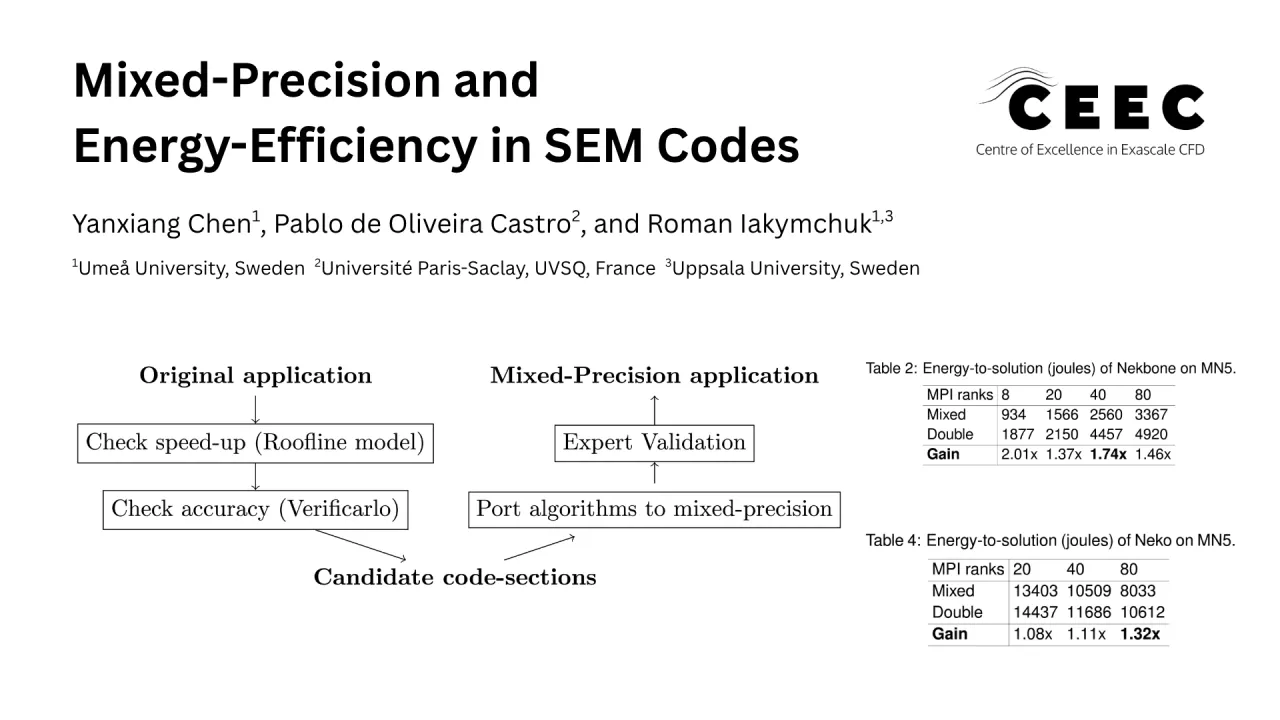
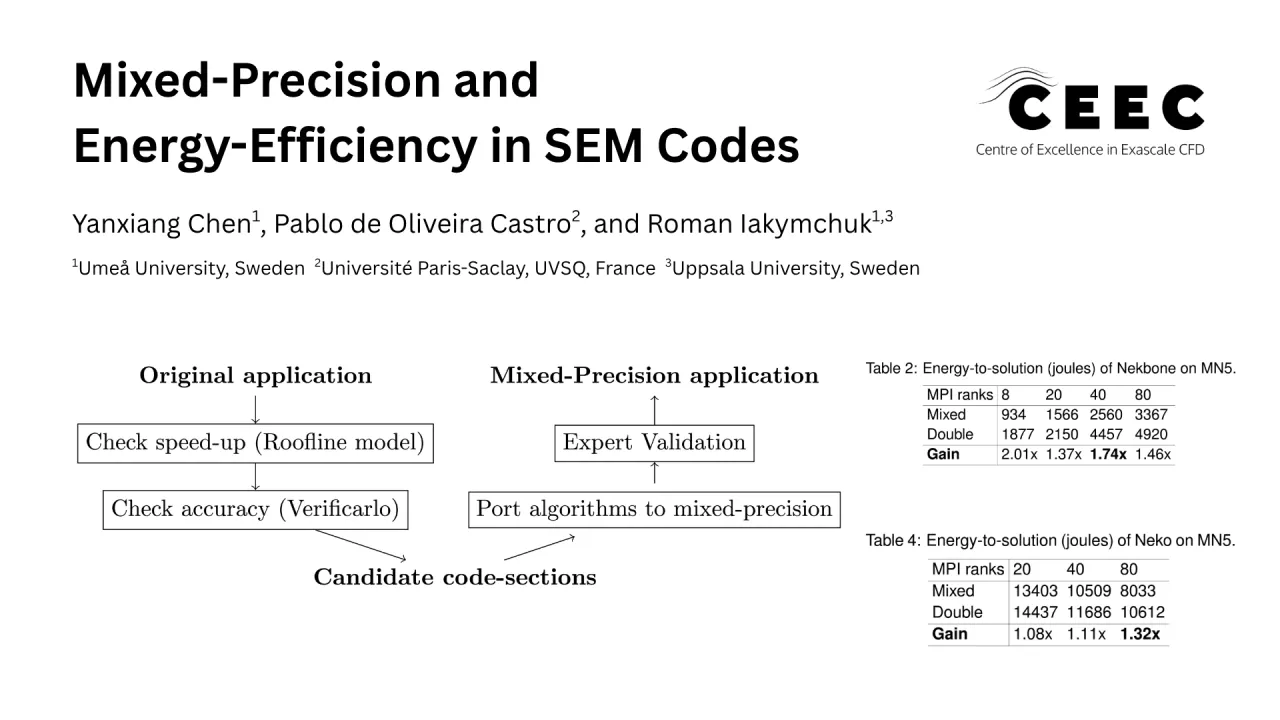
Our approach leverages three complementary components: first, computer arithmetic tools, such as Verificarlo, to instrument and analyze floating-point behavior throughout an application; second, a roofline performance model to quantify the potential computational benefits of lower-precision arithmetic; and third, precision-aware numerical techniques to mitigate or eliminate instabilities introduced when reducing precision in critical algorithmic kernels. Together, these elements form a repeatable framework that guides developers in deciding where and how to apply mixed precision without compromising scientific correctness.
To demonstrate the effectiveness of our methodology, we apply it to two representative spectral element codes widely used in computational fluid dynamics (CFD): Nekbone and Neko. Nekbone is a mini-application proxy for the spectral element CFD code Nek5000, while Neko is a modern spectral element code used for solving incompressible Navier–Stokes equations. For each code, we perform a detailed precision analysis, identify precision-sensitive and precision-robust regions, and design mixed-precision variants accordingly.
In the Nekbone case study, our analysis reveals that mixed precision can significantly accelerate the Conjugate Gradient (CG) solver without adversely affecting convergence or solution quality. We address stagnation phenomena often observed in reduced-precision CG by integrating arithmetic verification with adaptive precision controls, effectively preserving numerical stability. When executed on the MareNostrum 5 supercomputer, the mixed-precision Nekbone achieves a 1.3x speedup in time-to-solution and a 1.74x reduction in energy-to-solution relative to the double-precision baseline, demonstrating substantial gains in both performance and energy efficiency.
For the full Neko application, we extend our precision strategy to a broader set of computational kernels, leveraging the insights gained from Nekbone and applying them within the context of the momentum solver in the Navier-Stokes equation on the Poisson example. The mixed-precision Neko implementation achieves a 1.21x reduction in execution time and a 1.32x reduction in energy consumption compared with the double-precision version, while maintaining solution accuracy.
These results confirm that mixed-precision approaches, when carefully designed and guided by arithmetic and performance analysis, can yield significant improvements on HPC platforms for real-world scientific applications. Our methodology provides a general blueprint for HPC developers to adopt mixed precision in other spectral element and iterative methods, ultimately contributing to more efficient utilization of future exascale systems.
Contributors:
Mixed-precision computing has emerged as a key strategy to improve performance and energy efficiency on current and future high-performance computing (HPC) systems. However, integrating mixed-precision into large, production-level scientific applications remains challenging due to concerns about numerical stability, accuracy, and the complexity of identifying which computations can safely tolerate reduced precision. In this work, we propose a systematic and practical methodology for enabling mixed-precision in spectral element codes by combining insights from computer arithmetic tools, performance modeling, and targeted algorithmic analysis.
Our approach leverages three complementary components: first, computer arithmetic tools, such as Verificarlo, to instrument and analyze floating-point behavior throughout an application; second, a roofline performance model to quantify the potential computational benefits of lower-precision arithmetic; and third, precision-aware numerical techniques to mitigate or eliminate instabilities introduced when reducing precision in critical algorithmic kernels. Together, these elements form a repeatable framework that guides developers in deciding where and how to apply mixed precision without compromising scientific correctness.
To demonstrate the effectiveness of our methodology, we apply it to two representative spectral element codes widely used in computational fluid dynamics (CFD): Nekbone and Neko. Nekbone is a mini-application proxy for the spectral element CFD code Nek5000, while Neko is a modern spectral element code used for solving incompressible Navier–Stokes equations. For each code, we perform a detailed precision analysis, identify precision-sensitive and precision-robust regions, and design mixed-precision variants accordingly.
In the Nekbone case study, our analysis reveals that mixed precision can significantly accelerate the Conjugate Gradient (CG) solver without adversely affecting convergence or solution quality. We address stagnation phenomena often observed in reduced-precision CG by integrating arithmetic verification with adaptive precision controls, effectively preserving numerical stability. When executed on the MareNostrum 5 supercomputer, the mixed-precision Nekbone achieves a 1.3x speedup in time-to-solution and a 1.74x reduction in energy-to-solution relative to the double-precision baseline, demonstrating substantial gains in both performance and energy efficiency.
For the full Neko application, we extend our precision strategy to a broader set of computational kernels, leveraging the insights gained from Nekbone and applying them within the context of the momentum solver in the Navier-Stokes equation on the Poisson example. The mixed-precision Neko implementation achieves a 1.21x reduction in execution time and a 1.32x reduction in energy consumption compared with the double-precision version, while maintaining solution accuracy.
These results confirm that mixed-precision approaches, when carefully designed and guided by arithmetic and performance analysis, can yield significant improvements on HPC platforms for real-world scientific applications. Our methodology provides a general blueprint for HPC developers to adopt mixed precision in other spectral element and iterative methods, ultimately contributing to more efficient utilization of future exascale systems.
Contributors:
Format
on-demandon-site