RESEARCH POSTER AWARD FINALIST: HADEER: Hybrid AI Driven Engine for Enhanced Reservoirs
Wednesday, June 24, 2026 at 3:45 PM to 5:15 PM · 1 hr. 30 min. (Europe/Berlin)
Foyer D-G - 2nd Floor
Research Poster
GeosciencesHPC Simulations enhanced by Machine LearningIndustrial Use Cases of HPC, ML and QCML Systems and FrameworksPhysics
Information
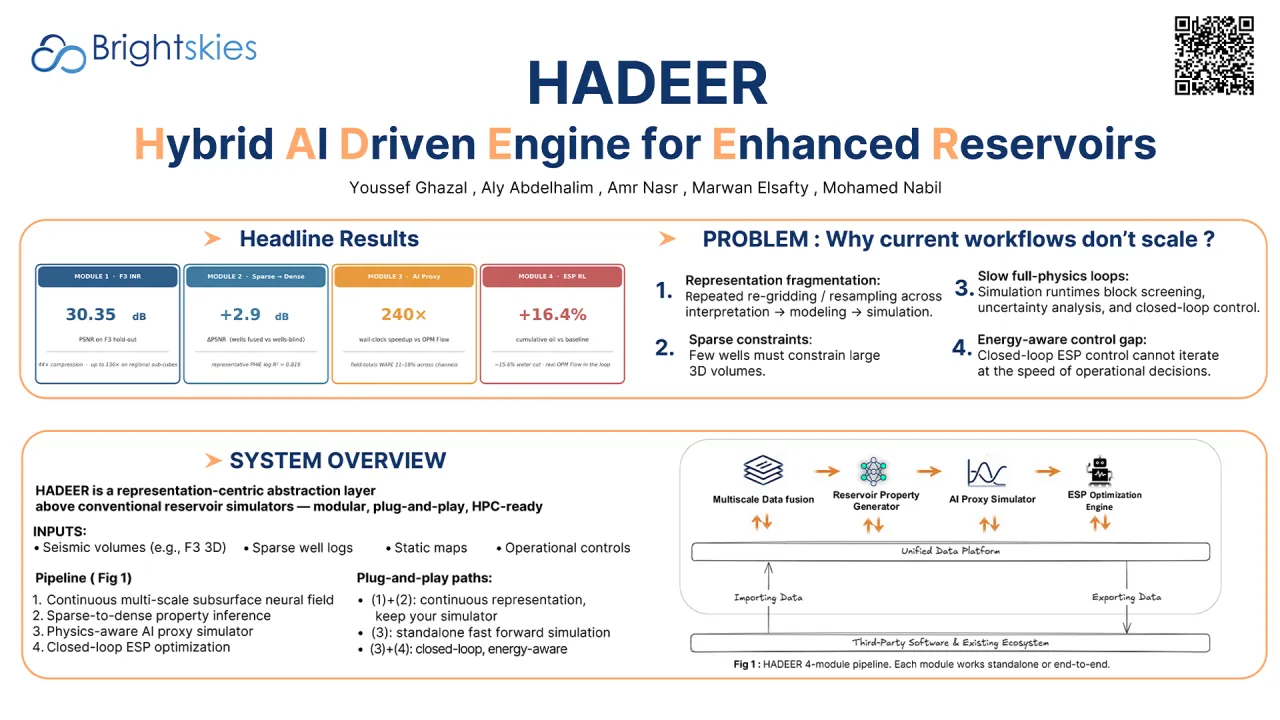
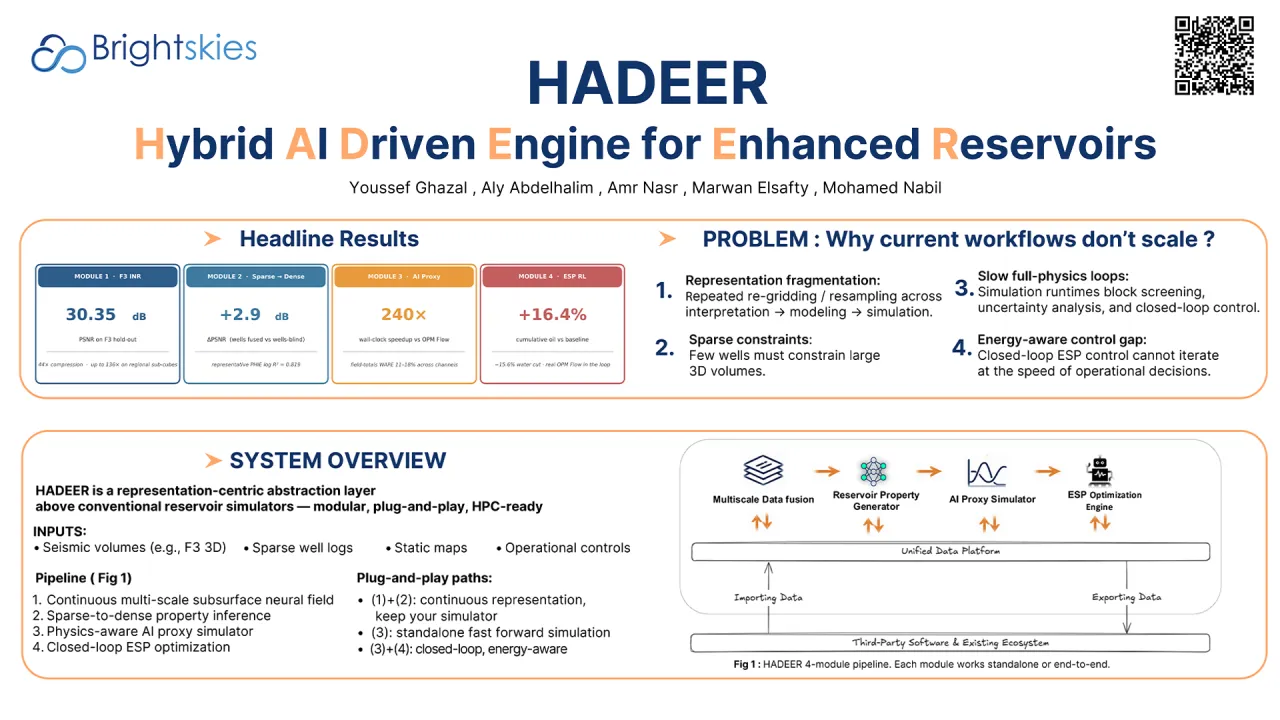
Reservoir modeling and production optimization remain constrained by fragmented toolchains, sparse subsurface observations, and the high computational cost of fully implicit physics-based simulators. In practice, teams manage multiple disconnected representations of the same subsurface system and repeatedly re-grid and resample data between interpretation, modeling, simulation, and optimization. These handoffs introduce scale mismatches that slow scenario evaluation, restrict uncertainty exploration, and hinder closed-loop optimization at field scale.
We present HADEER (Hybrid AI Engine for Enhanced Reservoirs), a modular pipeline that organizes workflows around a shared, continuous subsurface representation and couples it with fast proxy simulation and energy-aware control. HADEER introduces a representation-centric abstraction layer above conventional reservoir simulators: a coordinate-conditioned neural field provides a reusable, multi-resolution view of the subsurface that can be queried on demand, while sparse-to-dense conditioning uses limited well control to infer simulation-ready static property volumes aligned to seismic structure. For fast scenario evaluation, HADEER trains a physics-aware surrogate to emulate fully implicit black-oil simulation using HPC-generated ensembles, enabling scalable optimization loops that can explicitly incorporate operational constraints and energy metrics (e.g., ESP control).
We validate our framework on the Netherlands Offshore F3 3D seismic survey, where the learned implicit neural representation reconstructs held-out slices with PSNR ≈ 29.6–29.7 while compressing ~666 MB into a ~15 MB model (≈44×), and achieves up to 136× compression on larger regional datasets while preserving key reflectors and structural continuity. Using the same seismic-aligned backbone, sparse-to-dense conditioning produces dense porosity (PHIE) volumes consistent with regional seismic trends and hard well constraints, achieving strong agreement at well locations (e.g., R² = 0.819 on a representative well comparison) and generalizing to categorical seismic-derived attributes such as facies.
On the simulation side, a physics-aware proxy trained on OPM Flow ensembles for SPE9 (9,000 cells) delivers ~10× speedup over fully implicit runs, enabling orders-of-magnitude broader scenario and control exploration; in ESP-driven settings, proxy-coupled reinforcement learning reduces ESP-related energy consumption by 10–20% while maintaining production targets, with observed recovery uplift of 1–3% in evaluated cases. The poster highlights how a shared continuous representation reduces workflow fragmentation and how HPC-native data generation enables optimization-ready surrogate simulation and energy-aware decision making at scale.
HADEER was selected as the 1st-place solution in the RDIA AI Co-Innovation Program (Saudi Arabia).
Contributors:
We present HADEER (Hybrid AI Engine for Enhanced Reservoirs), a modular pipeline that organizes workflows around a shared, continuous subsurface representation and couples it with fast proxy simulation and energy-aware control. HADEER introduces a representation-centric abstraction layer above conventional reservoir simulators: a coordinate-conditioned neural field provides a reusable, multi-resolution view of the subsurface that can be queried on demand, while sparse-to-dense conditioning uses limited well control to infer simulation-ready static property volumes aligned to seismic structure. For fast scenario evaluation, HADEER trains a physics-aware surrogate to emulate fully implicit black-oil simulation using HPC-generated ensembles, enabling scalable optimization loops that can explicitly incorporate operational constraints and energy metrics (e.g., ESP control).
We validate our framework on the Netherlands Offshore F3 3D seismic survey, where the learned implicit neural representation reconstructs held-out slices with PSNR ≈ 29.6–29.7 while compressing ~666 MB into a ~15 MB model (≈44×), and achieves up to 136× compression on larger regional datasets while preserving key reflectors and structural continuity. Using the same seismic-aligned backbone, sparse-to-dense conditioning produces dense porosity (PHIE) volumes consistent with regional seismic trends and hard well constraints, achieving strong agreement at well locations (e.g., R² = 0.819 on a representative well comparison) and generalizing to categorical seismic-derived attributes such as facies.
On the simulation side, a physics-aware proxy trained on OPM Flow ensembles for SPE9 (9,000 cells) delivers ~10× speedup over fully implicit runs, enabling orders-of-magnitude broader scenario and control exploration; in ESP-driven settings, proxy-coupled reinforcement learning reduces ESP-related energy consumption by 10–20% while maintaining production targets, with observed recovery uplift of 1–3% in evaluated cases. The poster highlights how a shared continuous representation reduces workflow fragmentation and how HPC-native data generation enables optimization-ready surrogate simulation and energy-aware decision making at scale.
HADEER was selected as the 1st-place solution in the RDIA AI Co-Innovation Program (Saudi Arabia).
Contributors:
Format
on-demandon-site