CSR to SNN Pipelines for Neuro-Inspired Platforms
Wednesday, June 24, 2026 at 3:45 PM to 5:15 PM · 1 hr. 30 min. (Europe/Berlin)
Foyer D-G - 2nd Floor
Research Poster
EngineeringNovel AlgorithmsParallel Numerical AlgorithmsPost Moore Computing
Information
Poster is on display and will be presented at the poster pitch session.
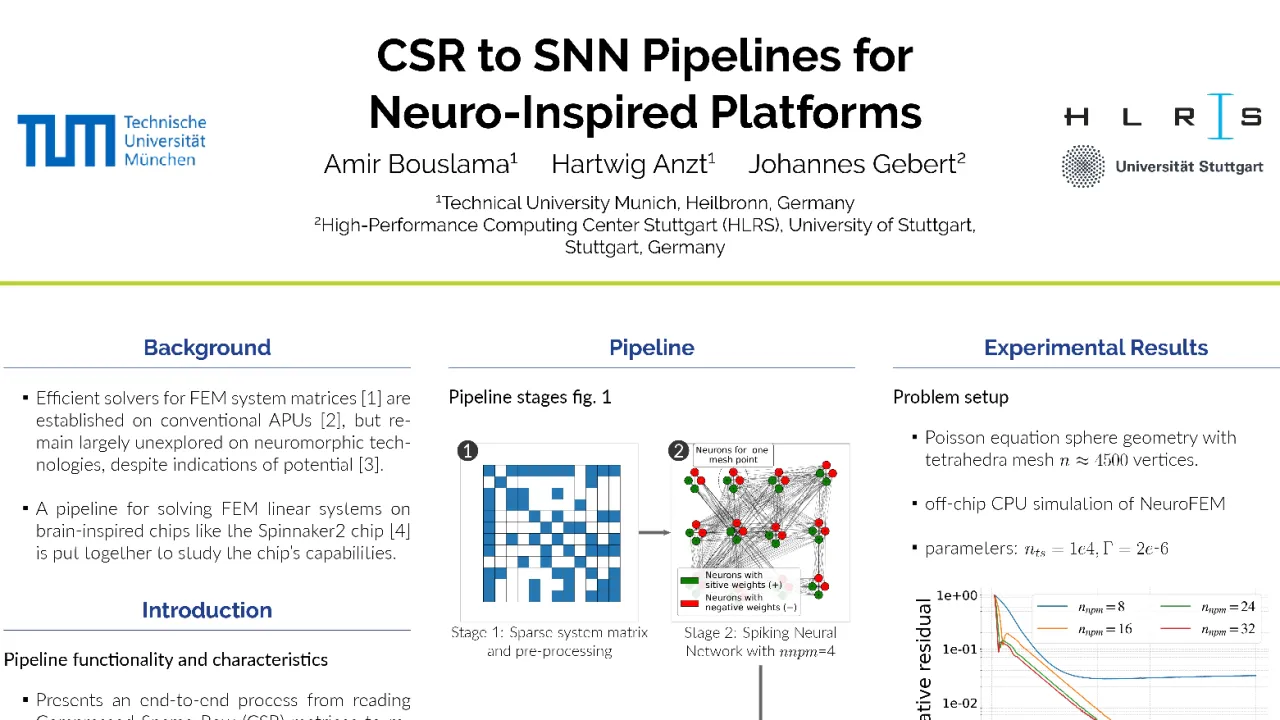
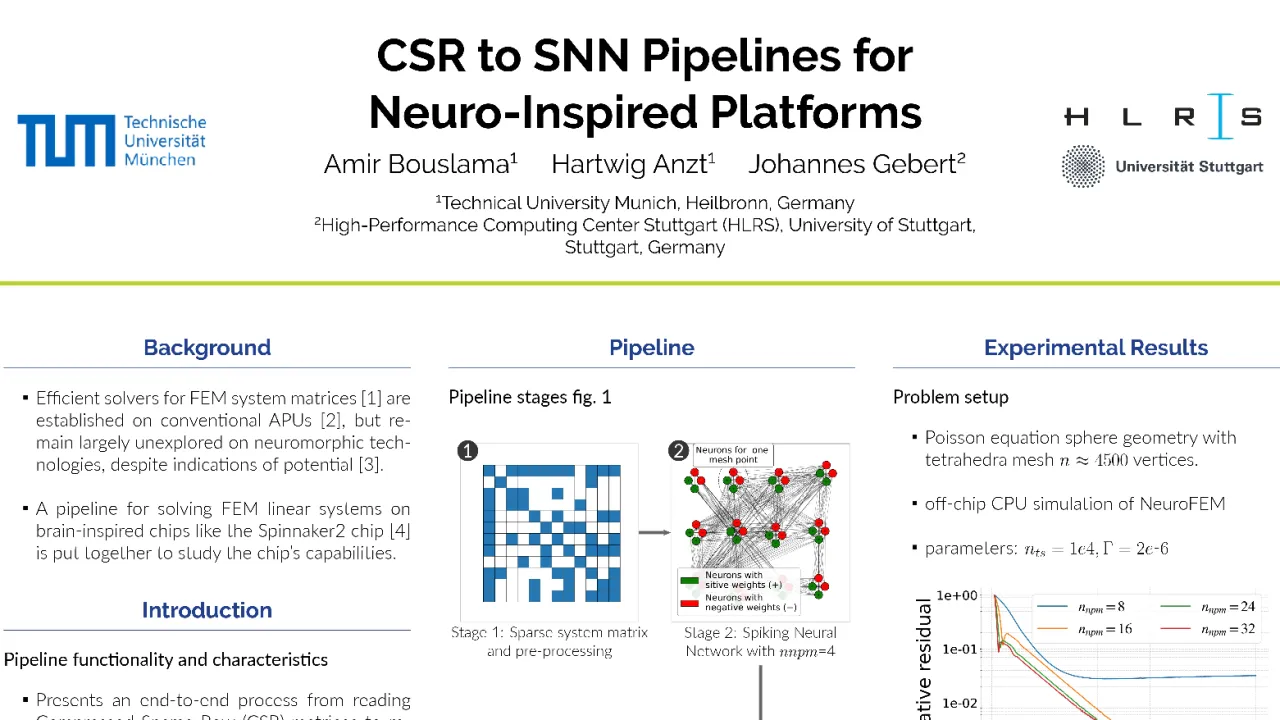
Solving sparse linear systems is a central task in the Finite Element Method (FEM). While conventional CPU- and GPU-based solvers are highly optimized, neuromorphic hardware offers an alternative computing paradigm. In this work, we present an end-to-end pipeline that maps sparse FEM system matrices to spiking neural network (SNN) representations and executes the resulting solver on SpiNNaker2 neuromorphic hardware.
The proposed pipeline starts from the FEM system matrices. Real-valued, nonzero matrix entries are converted into integer-valued synaptic weights through a controlled quantization process that respects SpiNNaker2 hardware constraints. Each FEM degree of freedom is represented by a configurable number of neurons per mesh node, enabling signed interactions via separate positive and negative weighted neuron projections. The SNN is encoded in a compact connectivity structure that defines synaptic links between neuron groups. The resulting SNN is deployed to SpiNNaker2, where a Neuro-Finite Element solver expands the complete network and organizes the propagation and evolution of the SNN within the chip's synaptic fabric over a user-defined number of solver time steps. We assess the solver behaviour by reconstructing numerical solutions from spike histories.
In an experiment, we analyze the convergence of the neuro-inspired FEM solver algorithm for a fixed number of time steps, off-chip, on a Poisson problem defined on a discretized spherical geometry. Multiple SNN configurations are evaluated by varying the number of neurons per mesh node. The experiments demonstrate that the neuromorphic solver can produce meaningful approximations to the FEM solution and that convergence depends strongly on the SNN's representational capacity and complexity. In particular, larger SNNs with a higher number of neurons per degree of freedom exhibit more sustained residual reduction, whereas more compact SNN representations reach convergence plateaus earlier.
Beyond assembling the pipeline for solving sparse linear systems on neuro-inspired hardware, several key challenges emerge. For large problem sizes, host-side matrix assembly and data transfer are expected to become dominant and may outweigh the advantages introduced by the neuro-inspired solver. Consequently, future work will investigate matrix-free assembly approaches tailored to neuromorphic hardware, as well as related directions such as distributed workflows that leverage neuro-inspired systems or the integration of a parallelized host machine with a SpiNNaker2 chip.
Overall, this work establishes a pipeline framework for solving sparse linear systems arising from FEM discretization on neuromorphic hardware using SNNs. It therefore provides a foundation for further exploration of neuromorphic approaches to solving FEM systems, which will be required to extend such approaches to larger scales.
Contributors:
Solving sparse linear systems is a central task in the Finite Element Method (FEM). While conventional CPU- and GPU-based solvers are highly optimized, neuromorphic hardware offers an alternative computing paradigm. In this work, we present an end-to-end pipeline that maps sparse FEM system matrices to spiking neural network (SNN) representations and executes the resulting solver on SpiNNaker2 neuromorphic hardware.
The proposed pipeline starts from the FEM system matrices. Real-valued, nonzero matrix entries are converted into integer-valued synaptic weights through a controlled quantization process that respects SpiNNaker2 hardware constraints. Each FEM degree of freedom is represented by a configurable number of neurons per mesh node, enabling signed interactions via separate positive and negative weighted neuron projections. The SNN is encoded in a compact connectivity structure that defines synaptic links between neuron groups. The resulting SNN is deployed to SpiNNaker2, where a Neuro-Finite Element solver expands the complete network and organizes the propagation and evolution of the SNN within the chip's synaptic fabric over a user-defined number of solver time steps. We assess the solver behaviour by reconstructing numerical solutions from spike histories.
In an experiment, we analyze the convergence of the neuro-inspired FEM solver algorithm for a fixed number of time steps, off-chip, on a Poisson problem defined on a discretized spherical geometry. Multiple SNN configurations are evaluated by varying the number of neurons per mesh node. The experiments demonstrate that the neuromorphic solver can produce meaningful approximations to the FEM solution and that convergence depends strongly on the SNN's representational capacity and complexity. In particular, larger SNNs with a higher number of neurons per degree of freedom exhibit more sustained residual reduction, whereas more compact SNN representations reach convergence plateaus earlier.
Beyond assembling the pipeline for solving sparse linear systems on neuro-inspired hardware, several key challenges emerge. For large problem sizes, host-side matrix assembly and data transfer are expected to become dominant and may outweigh the advantages introduced by the neuro-inspired solver. Consequently, future work will investigate matrix-free assembly approaches tailored to neuromorphic hardware, as well as related directions such as distributed workflows that leverage neuro-inspired systems or the integration of a parallelized host machine with a SpiNNaker2 chip.
Overall, this work establishes a pipeline framework for solving sparse linear systems arising from FEM discretization on neuromorphic hardware using SNNs. It therefore provides a foundation for further exploration of neuromorphic approaches to solving FEM systems, which will be required to extend such approaches to larger scales.
Contributors:
Format
on-demandon-site
Speakers

Amir Bouslama
StudentGermany