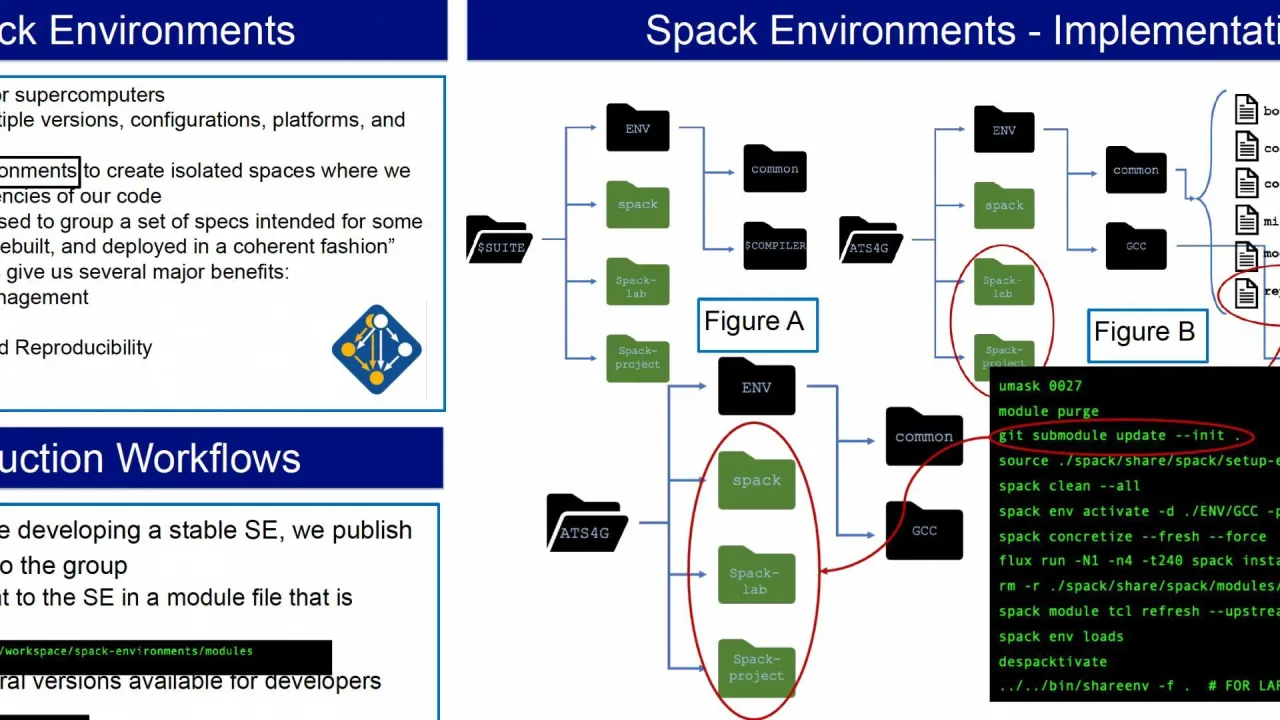
Poster is on display and will be presented at the poster pitch session.
Developing sustainable scientific software requires addressing challenges in integration, maintainability, and reproducibility—particularly in the context of high-performance computing (HPC) environments where deep software stacks and mature codes dominate. Integrating new packages into these stacks often involves extensive configuration, dependency management, and testing to ensure compatibility and performance.
At Los Alamos National Laboratory, we have adopted Spack, a powerful supercomputing package manager, to tackle these challenges. By automating dependency management, simplifying software configuration, and ensuring compatibility across our software stack, Spack has significantly reduced the overhead associated with integrating and maintaining new software packages. Central to our approach is the use of Spack Environments, which enable us to define, manage, and reproduce software environments with ease. This capability not only streamlines development workflows but also ensures long-term sustainability and reproducibility of our software stack.
In this poster, we will share our experience integrating Spack into our workflow, with a particular focus on how Spack Environments have transformed the way we manage complex dependencies and maintain software over time. By demonstrating the tangible benefits of Spack in promoting sustainable software practices, we aim to provide a framework that can be adapted and applied across the broader scientific software community.
LA-UR-25-20567
Contributors: